
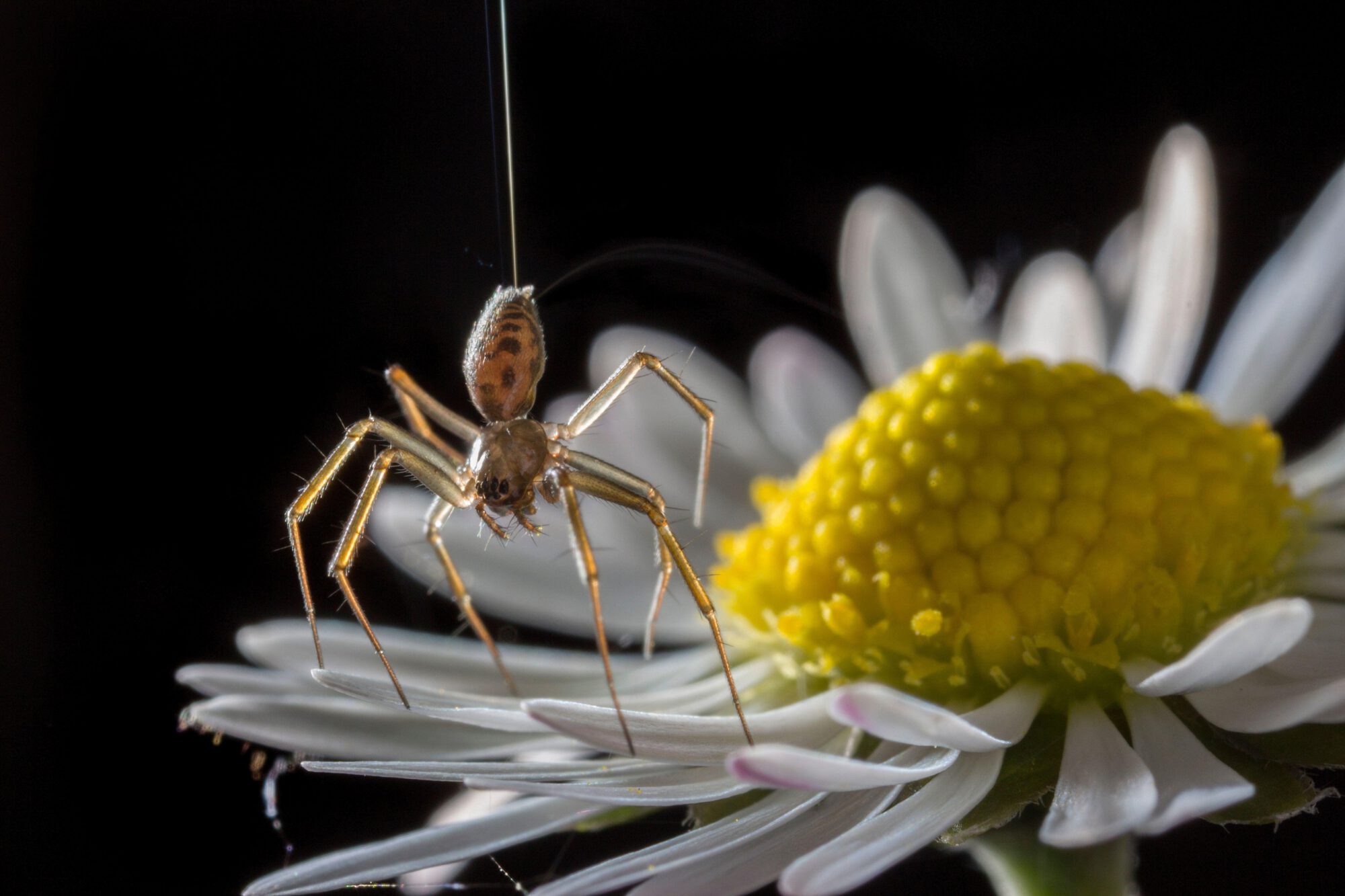


Spiders make different silk for different jobs. Dragline silk, which they spin for the mode of transportation we call “ballooning,” is what the U.S. military considers the best kind. It is five times stronger than steel, and more flexible and resistant to extreme temperatures. This is the stuff that, over a decade ago, inspired humans to splice the gene responsible for its production into a multiplicity of fertilized goat embryos, in the hopes of birthing a goat that would allow people to milk out what spiders will not produce on command.
The inclinations that have, repeatedly, caused spiders to evolve the ability to balloon also make spiders difficult livestock. Spiders balloon, in part, to get away from other spiders—in close quarters, they eat each other. It has so far seemed easier to put spider genes into domesticated species (then goats, now silkworms) than to domesticate the spiders.
Sometimes, a spider balloons just to get to the next flower, says Lauren Esposito, chair of arachnology at the California Academy of Sciences. In the Bay Area, one of the most common spiders that does this is the goldenrod crab spider (Misumena vatia). “If you get to enough flowers,” says Esposito, “you’re likely to find one.” It is so fond of ballooning that it doesn’t bother to spin a web to catch prey—it just lurks inside fresh blooms, waiting for unsuspecting pollinators. Expect to look closely—underneath their exoskeletons, M. vatia have guanine crystals—the same organic crystals that give fish and reptiles their shimmer—that they can open and close to shift color and better camouflage themselves.
Sometimes, a spider balloons a lot farther. All 16 species of long-jawed orb weavers (Tetragnatha) on the Hawaiian Islands are descended from a single spider that arrived in Kauai 5 million years ago, when the island was no more than a baby assemblage of basaltic lava flow. That ancestral spider shares a suspicious amount of DNA with Tetragnatha currently residing in California.

As one of the few creatures light enough to get the air to do most of the work of moving them around, spiders are often early to the party. A spider was the first living thing sighted after the eruption of Krakatoa in 1883. In 1832, as a young Charles Darwin sailed around the world on the HMS Beagle, he wrote in his journal that the prevailing fantasy of young islands being populated first by “noble tropical plants” and then other species later was not holding up under his observations, which were coming up zero on plants but heavy on spiders.
The Beagle’s voyage intersected several times with the voyages of ballooning spiders. Darwin, who dubbed them “little aeronauts,” passed much of a day where the Beagle sat becalmed 60 miles off the coast of Argentina, watching spiders as though they were television, “I repeatedly observed the same kind of small spider, either when placed or having crawled on some little eminence, elevate its abdomen, send forth a thread, and then sail away horizontally, but with a rapidity which was quite unaccountable.” It couldn’t be the wind, he added, because there wasn’t any.
On another calm day, Darwin noted, he watched another little aeronaut climb to the top of a post on the ship’s deck, where it “darted forth four or five threads from its spinners. These, glittering in the sunshine, might be compared to diverging rays of light; they were not, however, straight, but in undulations like films of silk blown by the wind. They were more than a yard in length, and diverged in an ascending direction from the orifices. The spider then suddenly let go of its hold on the post, and was quickly borne out of sight.”
Over 170 years after that spider sailed past Darwin, in the year 2009, Peter Gorham, a physicist at the University of Hawaii, read these words and thought, “Hm.”
Gorham was not reading the Voyage of the Beagle for the spiders. An avid sailor, he had picked it up to relax with a good ocean yarn. But it was immediately clear to him, from Darwin’s description, that these spiders were up to something.
We live in a giant battery, Gorham explains: There are negatively charged electrons in the earth. There are positively charged ions in the upper atmosphere. If spiders could launch horizontally, at rapid speed, in the absence of perceptible wind, they must be, Gorham figured, using the earth’s electrical field to propel themselves.
Gorham went looking for the literature to confirm this. He didn’t find any, which surprised him. Even Darwin had speculated that electricity could be involved. So Gorham wrote a paper explaining how, if a spider could transmit an electrical charge to its silk, it could use the silk to levitate in the earth’s magnetic field. The calculations were a piece of cake, he said. Undergraduate-level physics.
None of the scientific journals he contacted would publish it. This, they told him, was a matter of biology. Where was his biology lab? Where were his spiders? Gorham gave up and posted the paper on arXiv, a server for unpublished research.
Five years later, two biologists at the University of Bristol published a paper in Current Biology proving Gorham’s theory. A post-doc named Erica Morley had found Gorham’s preprint and devised an experiment to test it—a box, isolated from the electricity of the outside world by a Faraday cage. Inside: a tiny spider launch platform made of cardboard, a parallel plate capacitor to replicate the earth’s electromagnetic field, and a spider (or rather, a succession of spiders).

When the capacitor was turned on, the spider’s trichobothria—the fine hairs on its legs, used to detect flight conditions—twitched. The spiders climbed to the highest point of the spider launch platform and began tiptoeing—waving a few legs in the air speculatively then arching up, butt high, and sending out a dragline. A few even launched. When the capacitor was off, none of the spiders tiptoed—they just hung out, doing regular spider things. “Just a beautiful result,” said Gorham. “A thousand times better than what I had written.”
Gorham and Morley began corresponding. Morley shared her data, Gorham used it to calculate how much charge the spiders that did launch were carrying on their webs, and the two published a paper together. It’s a rare delight, Gorham says, to collaborate with someone in a very different discipline who is at the top of their game. It’s the only time he’s ever worked with a biologist.
Gorham is delighted at all the spider questions that remain unanswered. How the universe of little orifices on a spider’s abdomen combine proteins into tiny, nano-scale fibrils, without any glues. How a spider actually goes about separating ions and electrons in order to charge its web. “I don’t squish them any more,” he adds. “I respect them too much for that.”
Gorham last heard from Morley about five years ago. He lost track of her after her post-doc at the University of Bristol ended, and worries it may have been the end of her research career. (Morley was not available for an interview.) The academic job market has long been rough, but “it’s getting worse, of course,” he says. “If science were a planet, the asteroid is hitting right now.”
.cta-box-responsive{
overflow:hidden;
padding:6.25%;
position:relative;
height:auto;
margin-left:10%;
margin-right:10%;
margin-bottom:4%;
background-color: #000000;
color:white;
border-style: solid;
border-color:black;
text-align: center;
}
.cta-link-color {
color: #faa61a;
}
.cta-box-image {
display: block;
padding-top:10px;
margin-left: auto;
margin-right: auto;
width: 75px;
}
Sign up today!

As we’re talking, Gorham is at the Columbia Scientific Balloon Facility in Texas, testing equipment that will be loaded onto a NASA balloon and launched from Antarctica into the polar vortex. The vortex is strong enough to keep a balloon circling the South Pole at the very edge of space for nearly two months.
Since NASA started the balloon program in the 1960s, says Gorham, it’s been a way to study space at a fraction of the cost of a rocket launch. Now, it looks like it won’t last past the end of 2025. We’re going to lose a generation of scientists,” Gorham says. “It’s an extinction-level event for science in America.” For generations, countries around the world have been sending their young scientists to colleges and labs across the United States, borne across the ocean like so many little spiders. Now the currents are changing. “We’re going to be sending our kids abroad to get educated,” he says. “Hoping they come back someday.”
You must be logged in to post a comment.