


In the gently rolling hills of Point Reyes National Seashore, rangeland scientist Felix Ratcliff crouches down in the dirt in search of clues to the landscape’s former glory. Using a trowel, he excavates tiny soil samples from grasslands that have been grazed, burned, and managed by humans for hundreds or thousands of years—in search of evidence of the species that once thrived in the Seashore’s distant past, and could triumph again.
What wild plants once graced this landscape, before we arrived? If replanted and protected, can they help heal a long-lost habitat?
These questions take on new urgency in the wake of a dramatic legal settlement announced in January. For the first time in 150 years, Point Reyes will be almost empty of commercial ranching. Nearly every historic ranch will close, leaving one beef operation on the peninsula. All of the dairies will close. The park’s 18,000 acres of commercial ranchland will shrink by 88 percent, to just 2,200 acres. Ranchers will no longer steward the area. Instead, environmentalists will, in collaboration with the National Park Service.
Without quick action, the beloved landscape could become an eyesore, overgrown with invasive weeds and decaying structures. But with enough funding and focus, a five-year private-public partnership between The Nature Conservancy and the park seeks to manage and restore the seashore, returning large swaths of it to wilder roots.
“There will be a different kind of experience now. It will be more dominated by the opportunities to see wildlife and restored freshwater ecosystems. This is a new chapter for the seashore,” says The Nature Conservancy’s Mark Reynolds, a grasslands expert who has guided the organization’s restoration of Dangermond Preserve in southern California, which like Point Reyes, was once vast ranchlands.
“But it’s more complicated than it seems,” he says. “It’s not as simple as ‘remove the cattle and everything will be fine.’ ”
The new transition plan will transform a landscape that has long been an agricultural powerhouse, home to 27 dairies and beef ranches when the park was authorized in 1962. Conservation will be prioritized, while maintaining recreational access. Some fences will come down; others will get gates and “step overs” for hikers. Degraded and eroded habitats will be restored, where possible. Pastures will be grazed with small controlled herds of cattle, and perhaps mowed or burned. In time, there will be new trails for hikers, bikers and equestrians, maybe overnight options for visitors. Dozens of historic structures await decisions about their fate.
An estimated 1,000 acres of long-abandoned pasture will be left ungrazed, and may revert to woody coastal scrub, according to the plan. Remnants of rare coastal prairie will be closely studied by scientists, with an eye towards eventually expanding it through new plantings.
Under the old ranching regime, the landscape was deeply familiar. With the ambitious new plan—and the political, legal and financial challenges it faces—the future is less certain. It is unclear because planning is still under way and much remains to be determined—and because both PRNS and TNC officials largely limit their public discussions to what’s been published in the official “cooperative agreement” between the two organizations. The agreement between TNC and individual ranchers, promising a reportedly $30 million payout, is private. So Bay Nature has assembled a picture of what could be at Point Reyes from documents, scientists, and longtime area experts.
The plan for Point Reyes, in four maps
See where ranches are, where tule elk range, the new Scenic Landscape Zone, and where grazing will happen.


How coastal scrub gave way to grasslands
With its cool, clean winds, dense fog and ever-changing skies, Point Reyes was once a place of dense, impenetrable stands of coastal scrub and forested ridges, dotted with small patches of native perennials, bunchgrasses, and wetland plants. As people arrived—Coast Miwok, Mexican land grantees, dairy farmers, cattle ranchers, the federal government, and the contemporary influx of recreational visitors—each group asserted a distinctive and lasting signature on the land.
Grasslands were initially created and preserved by the Coast Miwok, who established villages on the peninsula about 10,000 years ago and ignited fires to maintain open areas for hunting elk, deer and antelope. European explorers, recognizing the land’s potential, also managed the land with burning and grazing. In 1793, a Spanish lieutenant named DeGoyoechea envisioned the peninsula from atop Mount Vision as “very good pasture and springs in all parts, very appropriate for raising cattle of all kinds and very extensive,” according to natural historian Jules Evens in his book The Natural History of Point Reyes. It also supported great herds of elk and other herbivores. While on an elk hunt at a Mexican ranchero in 1846, Paul Revere’s grandson Lieutenant Joseph Warren Revere described “not less than 400 head of superb fat animals,” wrote Inverness historian Jack Mason.
Domestication started in the late 1850s. Over time, the peninsula gained fame for its carpet of green and gold Mediterranean grasses, such as ryegrass and common velvet grass. Cattle replaced elk. Pioneers such as the Steele and Shafter families supplied milk, cheese and butter to San Francisco’s finest restaurants. At its commercial peak, the seashore held more than 30 ranches.

Since then, Point Reyes has held more Holsteins than humans. One of the few national parks with working agriculture, its pastoral panorama was never pristine, but froze a moment of America’s long-lost rural heritage, where wilderness and farming existed side by side.
The once and future prairie
Biologist Woody Elliott celebrates the pending departure of cattle, and nature’s unruly return. Once the park is relieved of constant agricultural pressure, the seashore could restore coastal grassland prairie, he says, expanding an endangered habitat that once stretched all the way from the San Francisco Bay to the Oregon border.
Hiking through a relict stand of prairie, located on a cow-free ridge near the parking lot of Marshall Beach, Elliot is exuberant—at 76, he has the bounding energy of a child let out to recess. Scattered clumps of tall native bunchgrasses, like startled mops of hair, are so tall and dense that it takes effort to weave a path and find secure footing. Still surviving in small isolated clusters that date back to pre-European times are long-lived perennial bunchgrasses such as purple needlegrass (Stipa pulchra), California fescue (Festuca californica) and California oatgrass (Danthonia californica), which stay green year-round with the moisture of the fog belt.

The windswept knoll feels almost sacred: Agriculture, invasion and development have reduced such grasslands in California by 99 percent over the last century, according to rangeland ecologists.
Now a research project, funded largely by the Point Reyes National Seashore Association is under way to better understand the history of the seashore’s grasslands, by revealing how species have shifted over time. Led by Ratcliff, soil scientists are measuring the abundance and shapes of ancient microscopic particles of silica, called phytoliths, that are formed in the tissues of grasses. The abundance of phytoliths at a site will tell them whether grasses were once plentiful. In addition, the park service is building a grass “seed bank” to aid future replanting.

“Isn’t it gorgeous? There’s all sorts of stuff,” says Elliott, an ecologist and former natural resource manager for California State Parks, as he wades through bold and stately Pacific reedgrass, tufted with arching green leaves and tan flower plumes. A native strawberry is tucked among brambles. In the distance, tufted hair-grass decorates a wet swale.
“Biology is not simple. It’s a mosaic,” he says, stopping to admire two types of coyote brush—one short, the other tall. “It’s beautiful.”
Silent barns, abandoned pastures
Tough economic times claimed many ranches, and the new legal settlement has delivered the final blow. Historian Dewey Livingston, 71, is haunted by what’s already gone—and fears that the National Park Service can never replace the stewardship of the Seashore’s agricultural land managers. He cherishes the ease of walking through grazed fields carpeted with violet Douglas irises and California buttercups. Close-cropped, the pastures offer thrilling glimpses of badgers, burrowing owls, meadowlarks or other grassland-loving species.
Year by year, he has watched the ranchers depart and pastures shrink. He mourns ruined barns, and forlorn ranch roads that are pot-holed and chassis-rattling. Weedy invasive plants are taking over. Some former grasslands have converted to highly flammable shrub stands.

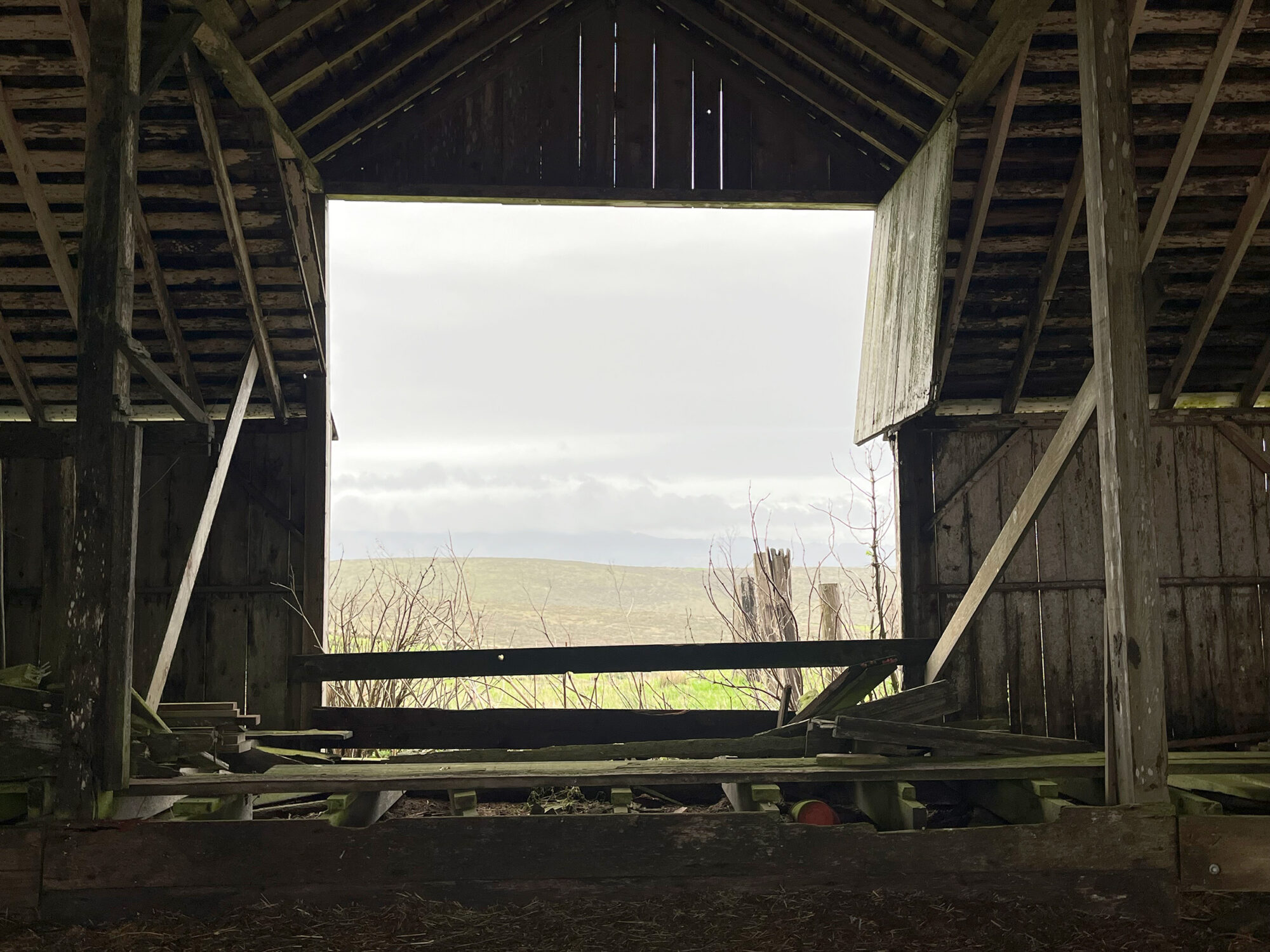
The historic D Ranch, for instance, was once a significant part of the Marin County dairy industry. Built near Drakes Beach between 1862 and 1872 and abandoned in the early 2000s after its lease expired, its home is now colonized by mice and termites. Mold is munching the gypsum board, rotting studs and joists. Water has snuck beneath failing roof shingles; windows are boarded up. A lupine bush entangles a broken light post, built in 1938 by craftsman Clementi Angeli of Olema. In corrals, cordlike vines of Cape ivy noose around hikers’ ankles like booby traps. Algae floats in rusty troughs. Tule elk, now free to roam, graze in an empty pasture. A northern flicker calls from a broken roof rafter, its shrill kyeeer breaking the silence.
Other abandoned ranches feel equally ghostly. The Stewart Ranch was emptied just a few years ago and has already been invaded by poison hemlock, wild radish, French broom and yellow starthistle. Invasive eucalyptus trees are consuming the biodiverse meadows of what was once the Teixeira Ranch. Trees also are expanding into the former South End Ranch and Olema Valley’s famed Randall Ranch, where an empty 1880s era Italianate home still stands.

Over time, some of the untended landscapes have matured into tougher stuff, like coastal scrub, thick with prickly coyote brush, California sagebrush, bush lupine and poison oak. This dense brush is favored habitat for rabbits, gray fox, and coastal mule deer, and birds like spotted towhees and wrentits. But it’s hard for human hiking.
Atop Mount Wittenberg, part of the former Bear Valley Ranch, “you once had 360-degree views” from the ocean to East Marin, Livingston recalled. Now the view is blocked by tall Douglas fir, the eternal bald hill no more. The meadows of Arch Rock and Double Point, pictured in the early 1960s as emerald-green and flower-strewn selling points for creating the park, are now impassable.
Can the new plan replicate the interventions of the past that sustained grasslands and coastal prairie? Or will invasives and coastal scrub take over?
Once the former Genazzi Ranch “had hills with the most beautiful lupine and poppy blooms you could believe,” recalls Livingston. After the family ended grazing at the request of the park service in 2022, “there’s nothing now.”

A ‘Scenic Landscape Zone,’ and other plans
The effectiveness of stewardship by The Nature Conservancy and the park service will determine which of these scenarios will ultimately prevail: restored grasslands or invasive overrun.
The plan is complex, involving an array of different projects. Much of the abandoned D Ranch will be free of grazing and allowed to go wilder, with coastal scrub consuming pastures and woody brush filling deep gulches. Despite two prescribed burns and native grass seeding, Italian ryegrass (Lolium multiflorum), a non-native annual planted for forage, dominates the original homestead area today.
Commercial ranching will be retained on 867 other acres of the Seashore, but cattle will be consolidated in places with fewer sensitive plant and animal species. The challenge will be how to manage the rest of the soon-vacant landscape: more than 17,000 acres of empty ranches, now renamed as a “Scenic Landscape Zone.”
With no predators, and no population limits, the tule elk population is expected to swell. Some animals will be fitted with GPS collars to help biologists stalk them. A new elk management plan will likely be required. Animals that leave the park will continue to be captured and moved, or euthanized.

To tackle the invasives, land managers may need to mow or conduct controlled burns. And beef cattle will come back in small numbers, as allies to this restoration effort. They’ll be enlisted for early, heavy, and repeated “targeted grazing”—where fields are divided into small and mobile sections—to rebuff invasive weeds. Such short periods of high-intensity grazing can create the short grass favored by birds like the horned lark, a squat bird with a jumbled song; low-intensity grazing encourages taller grass for species like the savannah sparrow. All this grazing will be choreographed, with herds adjusted for rainfall, plant growth, and birds’ nesting seasons.
Stream crossings, originally installed to direct cattle, could be modified or removed. Water troughs will stay, but will require ‘escape ramps’ to prevent drownings of snakes, lizards, birds, bats, and other smaller species.
Restoration’s success is not guaranteed
It is not the first time that California’s damaged farmland will undergo retirement and attempted restoration, with lessons learned by trial and error—as shown by examples across the region and state.
Within only three years of removing cattle from his newly purchased rangeland in Nicasio, eight miles from Point Reyes, John Wick of Nicasio Native Grass Ranch watched his pastures fill with invasive woolly distaff thistle (Carthamus lanatus). “You can’t walk across your grass fields any more because this thing is cutting up your legs,” he says. The system had shifted, all of a sudden. “Grass needs to be grazed. Doing nothing,” he says, “is doing something.”
Restoration required seven years of intensive micromanagement, with mulching, chipping and application of compost, Wick says. Small herds of cattle were reintroduced to 67 discrete grazing “cells” of pasture, then monitored closely. Within a year, native plants reappeared and the number of meadowlarks surged. “This is the hardest I’ve ever worked,” he says. “Now I have whole fields of beautiful native grasses.”
Alongside busy Highway 4 near Hercules, the churn and divots from cattle hooves create perfect little pools that support the last-known stand of Contra Costa goldfields (Lasthenia conjugens) in Contra Costa County on a 30-acre preserve of the John Muir Land Trust. Grazing there helped suppress invasives so that goldfields might thrive, according to the trust.
Restoration of The Nature Conservancy’s Jack and Laura Dangermond Preserve, a 24,364-acre former cattle ranch that sits at Point Conception, west of Santa Barbara, has proven successful, according to the organization. It includes a working beef cattle operation, but in a way that also allows wildlife to roam. Some slopes are grazed to keep grasses and shrubs low; in others, grazing is off-limits. Through controlled burns, mowing and planting of oak seedlings, land managers are turning 150 acres of former agricultural fields into forests.

But other efforts, such as a federal effort to “rewild” pockets of the San Joaquin desert at Atwell Island and Tranquillity, are more frustrating. There, native seeds were long gone from the soil after decades of farming; commercial seeds had poor genetic diversity and were prohibitively expensive. So land managers learned to accept more modest success by focusing on just a few native species of shrubs, annual wildflowers, and annual grasses, to recreate small historic plant communities that could aid long-term recovery. Full restoration of similar desert ecosystems may be beyond the scope of most large-scale projects—or even impossible, after decades of farming, the group concedes in the 2021 Nature Conservancy book Rewilding Agricultural Landscapes.
.cta-box-responsive{
overflow:hidden;
padding:6.25%;
position:relative;
height:auto;
margin-left:10%;
margin-right:10%;
margin-bottom:4%;
background-color: #000000;
color:white;
border-style: solid;
border-color:black;
text-align: center;
}
.cta-link-color {
color: #faa61a;
}
.cta-box-image {
display: block;
padding-top:10px;
margin-left: auto;
margin-right: auto;
width: 75px;
}
Sign up today!

Fierce headwinds
Point Reyes’ grand vision faces political, legal and financial challenges as daunting as the ocean wind that races across these coastal hills.
Earlier this month, House Republican lawmakers launched a federal investigation into the Biden-era settlement agreement, citing what it called a “lack of transparency” and potential “environmental and legal consequences.” If this causes the deal to unwind, the park could end up back in court. Faced with continued commercial ranching, The Nature Conservancy could lose interest in its stewardship agreement, says Congressman Jared Huffman, whose district includes Point Reyes.
Meanwhile, two lawsuits have been filed in connection with the plan. One, filed by Niman Ranch founder William Niman and his wife Nicolette Hahn Niman, says the deal will irreparably harm to the park’s agricultural heritage. Dave Evans of Marin Sun Farms, who was not party to the settlement, and to whom the park service offered new 20-year leases, has joined the Niman suit. Another, filed by Marin lawyer Andrew Giacomini, aims to block the eviction of ranch tenants and workers.
The plan also depends on considerable—and at this point, unspecified—amounts of money. “Active restoration is expensive,” The Nature Conservancy’s book says. “Public money for restoration exists but it is hard to get and may be even harder to get in more challenging economic times.”
The park service currently has little funding to offer—and will lose income that the ranch leases once delivered. Already, Point Reyes’ core budget is under stress, declining 44 percent in real terms from 2014 to 2024. There’s little optimism that federal environmental support will arrive during Trump’s second term, which is already delivering fierce cuts to jobs, programs, and grants across the nation.
Private funding will be essential. Meanwhile, as part of its five-year agreement with the park, The Nature Conservancy is building a coalition of local organizations with deep expertise in ecological management, science, research, and restoration. Conversations among these organizations, including the Marin Agricultural Land Trust and Audubon Canyon Ranch, have already begun. “The Nature Conservancy is prepared to invest significantly in science and restoration to support NPS’s park management objectives,” writes Heather Gateley, spokesperson for the California chapter of the group, in an emailed statement.
Will private funding be enough to support the seashore’s longer term stewardship? That’s a decision for the future, after The Nature Conservancy’s five-year lease option expires. The park is offering a 20-year lease, with the option to renew for two additional 10-year terms.


What plants once grew here? Rand Evett of UC Berkeley samples soil at Point Reyes National Seashore to find out. In the soil are phytoliths, inorganic silica remnants left by the plants of yore. (Courtesy of Point Reyes National Seashore Association)
Rewilding lost landscapes through science
Though the future is in limbo, scientists continue their research on the landscapes of Point Reyes. One thing they already know: The land won’t heal itself. “You would think that if you get rid of the disturbance, it will revert to a native Eden,” says Reynolds, of TNC. “That’s not the case in these California systems, where you’ve had the predominance of non-native European and Asian grasses for many many years.”
Scientists don’t even know, for much of the park, what types of plants used to be here—and which areas are suitable for a restoration effort. So the park is working with the UC Berkeley team of grassland experts, led by James Bartolome, to describe the soil and plants on 65 plots on several ranches, says Ratcliff of Rangeland Conservation Science, an independent consultancy on the project team.
Their crews are out on those plots, drilling into the earth with hand-powered augers to extract soil cores, then measuring levels of nitrogen, phosphorus, potassium, calcium, sulphate and other nutrients. They are analyzing the soil’s texture: is it mostly sand, silt or clay? The team is also searching for evidence of ancient phytoliths that offer clues to what once grew on the sites. Large amounts of this silica will indicate that a site was home to grasses for hundreds, perhaps thousands, of years; lower amounts mean it was once shrubby or woody.
Finally, scientists are building a native seed bank for future replanting. Seeds must be matched to a site’s soil, location, topography, light conditions, and the role it played in the historic landscape. Once germinated, the tiny sprouts will likely need ongoing protection with mowing, targeted invasive plant treatments, and perhaps fire. “It’s almost infeasible to think about turning back thousands and thousands of acres … to native grassland,” says Reynolds. “You can reseed and plant them in areas,” he says. “But it’s a very difficult challenge.”


The historic D ranch. Lupine entangles a decorative light post that was built in 1938. (Lisa M. Krieger)
Changing land use—and altering history—presents an exciting prospect, despite the headwinds, he says. “This will be a very massive project, but one with a lot of learning potential,” he says.
As spring sunshine warms the peninsula’s hills, the ranchers are packing up. On the J Ranch, third-generation dairymen have shipped the last 50 Holsteins to a buyer in Texas. Down the road on the I Ranch, silage fields and a 150-year-old hay barn sit vacant. Elsewhere, there’s talk of starting over in the Sierra foothills, maybe even Oregon. A wild wind blows through empty pastures, where the chatter of starlings is replacing the stirring of cows.
You must be logged in to post a comment.