


On March 1, almost two months after the Los Angeles fires, California Governor Gavin Newsom issued a statewide proclamation to fast-track the clearing of fire-prone vegetation by temporarily snubbing California’s standard environmental review processes.
“We could clear out, dare I say, the thickets of all the bureaucracy,” Newsom said at a webinar on April 11.
Under Newsom’s proclamation, any wildfire prevention entity can apply until the end of this year for their fuel reduction projects to forgo the full reviews required under the California Environmental Quality Act (CEQA) and the Coastal Act. After soliciting applications in mid-April, eleven fuel break projects in the state, including three fuel break projects by PG&E in Sonoma County, have been approved and are expected to begin in the next few months.
While CEQA and the Coastal Act have been crucial in protecting land from pollution and development over the past five decades by requiring public agencies to determine potential environmental impacts of a proposed activity and prevent significant, avoidable environmental damage, they hold a reputation of sucking time and money from fire prevention efforts.
“CEQA can take sometimes anywhere from 18 to 36 months to be approved,” says Coastal Fire Protection District chief Jed Wilson, who oversees several high fire hazard regions in coastal San Mateo County. “We’re hoping that that is drastically shortened.” And drastic sounds about right—environmental review can now be “completed in as little as 30 days,” according to a joint statement by the California Environmental Protection Agency and California Natural Resources Agency (CNRA).
Out of the ten agencies and organizations undertaking fire prevention work that Bay Nature has spoken to, a few have expressed interest in pursuing projects bypassing CEQA or the Coastal Act. While a couple agencies have expressed confidence they can take the necessary steps to limit environmental damage during their projects, biologists caution that deregulation can put species in danger. “CEQA was put in place for a reason,” writes wildlife biologist Jeff Alvarez. “If we aren’t considering the impacts of proposed activities then we don’t know what these kinds of activities will do.”


Before and after fuel break work along Chapman Drive in Marin, removing understory shrubs and some trees that may be hazardous, overcrowded, or invasive (Anne Crealock).
Winter rains and snow led to months of green grasslands in the Bay Area and snowpack in the Sierra. Still, wildfire in lowland areas this summer remains possible, according to CalFire’s 2025 seasonal outlook. “I stopped trying to predict fire seasons years ago,” says East Bay Regional Park District acting fire chief Khari Halae. Even in a “year we have a bunch of rain, while the vegetation is higher, that dries out.”
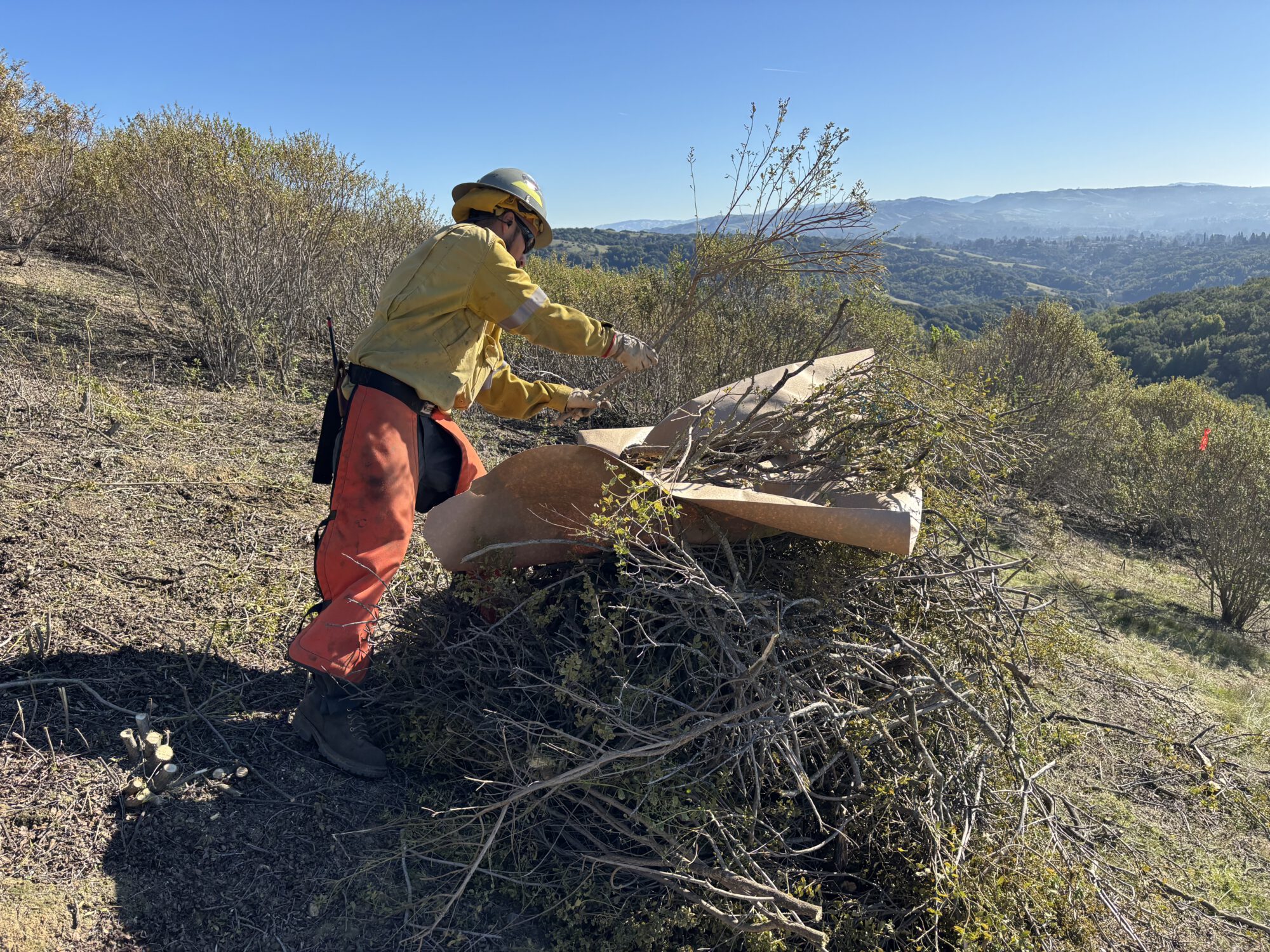
One way to combat this danger is with fuel breaks—thinning and removing trees and shrubs with chainsaws, chippers, excavators, herbicides, or more, best done in spring when the ground isn’t too wet and brush isn’t too dry. Once fire reaches a fuel break, it “burns slower,” says Halae. They provide opportunities for high hazard zones, often at the edge of suburbs and natural areas, to receive some much needed protection.
In Moraga and Orinda, “risk has increased [because] we’re building more homes in the wildland-urban interface,” says Moraga-Orinda Fire Department chief Jeff Isaacs. But “we’re not doing the fuel mitigation to the level that needs to be done.”
Under Newsom’s order, the Moraga-Orinda Fire Department may be able to create the fuel breaks Isaacs says the region needs. It’s these “municipalities or other organizations that don’t have the same resources that we have in our district” that will benefit the most, says Halae, whereas the EBRPD has its own stewardship department for permitting processes. “It’s smaller projects that are just struggling to get through,” said Newsom at the April task force meeting, “that led to this emergency proc[lamation].”
Still, the order may not be enough. While the Moraga-Orinda fire department had initially been interested in taking advantage of the order, “we just don’t have any funding for a project” or the ability to acquire funds and complete the work within the year, says Isaacs. “Unfortunately for us, it just doesn’t do us any good.”


Roadside fuel break at Guadalaupe Canyon Parkway by Fire Safe San Mateo County in 2022 (Denise Enea); fuel break at Live Oak Preserve in Sonoma County (Sonoma Land Trust).
The fuel break expansions moving forward sans CEQA, however, alarm Alvarez. “Governor Newsom really doesn’t have the background, context, or experience to understand what the impacts may be on any wildlife species,” he writes. Moraga and Orinda are home to the Alameda whipsnake, for example, a rare and endemic species that requires experts “to avoid localized extirpations,” he says.
In Half Moon Bay, critical species including the California red-legged frog, San Francisco garter snake, and monarch butterfly “can make projects a little bit more challenging to accomplish,” says fire chief Wilson. He is hopeful Newsom’s order will mean “not having to go through a full CEQA or Coastal Act approval,” he says.
But Newsom’s order isn’t “a carte blanche approval” for fire departments to forgo environmental regulation, says Wilson. In place of the acts is the Statewide Fuels Reduction Environmental Protection Plan, a streamlined environmental review based off of a similar plan in Newsom’s 2019 order expediting fire prevention projects. “We really don’t think that we’re trading off protections,” says CNRA Secretary Wade Crowfoot. “But we’re definitely trading off the length and cost of the assessment process,” like the environmental impact report and its review.
Reviews under CEQA and the Coastal Act require “drafting up large, complex documents” that take time, says Marin Wildfire Prevention Authority program manager Anne Crealock. In coastal Marin where there are also “a lot of sensitive species and habitats,” the authority hopes to bypass the Coastal Act to create a fuel break near homes in Bolinas, Inverness, and Stinson Beach. But even with a lighter load of paperwork, Crealock asserts that the order will not allow the authority to forgo the Environmental Protection Plan and its own environmental protection standards.
“We always have a biologist, for example, walking ahead of the crews to flag off any sensitive habitat,” says Crealock. “Dead trees with a lot of cavity nests, for example, we would leave on the landscape for wildlife habitat…we also always check to see if there’s potential for monarch habitat within a eucalyptus grove.”
This attention to detail may suffice for biologists like Amanda Murphy of Wildlife Science Consulting, who has monitored endangered species in California for over 20 years. “In certain areas with the proper environmental oversight…it may be necessary to bypass some of the aspects of CEQA that slow down fuels reduction,” Murphy writes. “But only if these programs are monitored in good faith.”
Still, Alvarez is skeptical of the order’s future implications. “I get that CEQA adds time to everything,” writes Alvarez. But “removing CEQA allows free-flowing impulsivity that future generations may have to pay for.” Especially after Trump’s takedown of the National Environmental Protection Act in January, undermining local protections further erodes the integrity of environmental regulation.
But “not taking risks,” said Newsom at the April webinar, “is the most reckless thing we can do.” With Newsom’s persistence, Crowfoot expects many more projects to come.


You must be logged in to post a comment.